
Attention is on national and global stages right now, naturally making fundraising for local work harder. When asking for investments in organizations who make communities work better – for instance, those advocating for better transportation options – a funder sentiment is often expressed that goes something like this: “we prefer to invest at the national / global scale”. Which is code for “it’s easier to give to large intermediaries with a nation / global presence.”
- The implication is that with broader reach comes greater impact.
- Yes, and money isn’t the most powerful scaling mechanism. People are.
- There is at least one in each large funder portfolio. The “go all in” campaign to, say, change the U.S. transportation system – that becomes a millions or billions invested, nothing much to show for it moonshot.
- Because it was a lot of policy / lobbying work that didn’t get adopted, or that got adopted and didn’t get implemented. Or that got adopted, partially implemented, and then along came a regime change. People weren’t sold on it first, so it blew in the wind.
- Yes, and money isn’t the most powerful scaling mechanism. People are.
This “go bigger or don’t bother” is cousin to another one that we get a lot: “there isn’t a lot of value in small grants.” Again, it’s easier to give more at once. For everyone involved: giver and receiver.
- The implication being that bigger amounts have higher impact.
- Sometimes, sure. If money was what makes things change more than people voting with their feet.
- If you need to just invest in infrastructure, for example, that doesn’t really require any marketing or behavior changes. There is a time and place for that strategy, like when a bridge needs replacing.
Having worked at every level of government and in or across every sector, it’s the local work that shows pretty immediate value. And, having granted large and small amounts at every scale, it’s often the smallest awards that show the greatest returns.
- Makes sense. They come with the least strings, aren’t mired in politics, slide under the radar and let people get creative in tackling a chronic problem. Why politicize something when you can just quietly get it done?
- When that creativity emerges into the light, it attracts resources. Snowballing for a sustained impact that scales on its own because others want to copycat.
What is in vogue right now is the concept of democracy. Bruce Mehlman’s Substack exploring the drivers of politics and policy did a feature recently on how people – who have the power to change everything when they organize or acquiesce – put their trust eggs into the local basket. This is a clip from his 6 charts on it:
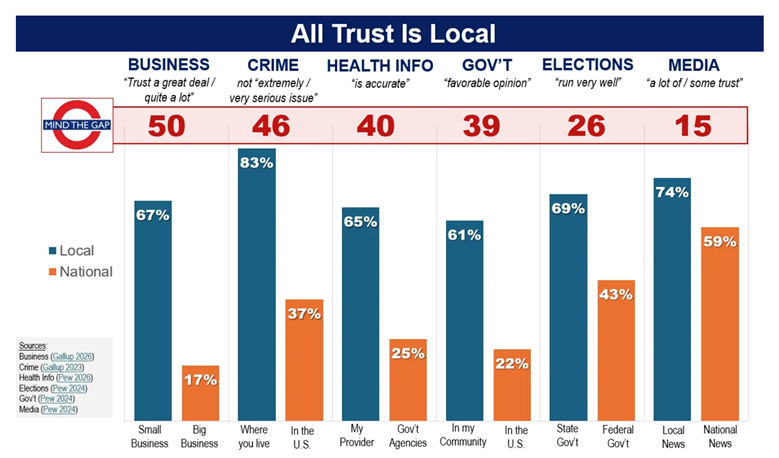
So even when communities themselves aren’t popular (and they do come and go as a hot or not-hot thing), they still contain the the keys to societal changes that these are hot. Right now for example restoring trust, getting / counting the vote, etc.
- Local should always be a part of the investment strategy. If it’s not, even the slickest innovation, the billion dollar campaign, the most progressive new policy will face the folded arms, the denied zoning, the refusal to adopt and adapt.
- There’s no better way to ground-truth something than to do a small, local grant and test its legs.
- The good ideas – the ones that ultimately change how we function as a society – take off like that vine that you pull up 5 times a summer: just try and stop it from scaling.